Building a Synchronous Southern Ocean Observatory
SYNCHRONY (Synchronous Southern Ocean Observatory) is a Horizon Europe research and innovation project dedicated to strengthening our understanding of Antarctica and the Southern Ocean—one of the most important yet least observed regions of the Earth system. The Southern Ocean plays a vital role
in regulating the global climate by absorbing excess heat and carbon dioxide, supporting unique marine ecosystems, and influencing sea level. However, rapid environmental change and growing human pressures are placing these critical systems at increasing risk.
Bringing together leading European and international research organisations, SYNCHRONY will establish a robust, internationally coordinated Southern Ocean observing system for long-term climate and ecosystem monitoring. By combining cutting-edge observations with advanced modelling, artificial intelligence, and interoperable data infrastructures, the project will improve our ability to detect change, understand complex ocean–ice–atmosphere interactions, and develop reliable indicators for climate and biodiversity.
SYNCHRONY will also strengthen international collaboration, promote open and FAIR data, and invest in training and capacity building to ensure the long-term sustainability of Antarctic observations. By making essential datasets more accessible and supporting major European and global initiatives, the project will provide the scientific evidence needed for informed decision-making, sustainable Antarctic governance, and effective climate action. In doing so, SYNCHRONY will contribute directly to the European Green Deal, the UN 2030 Agenda, and global efforts to safeguard our planet’s future.
News & Events
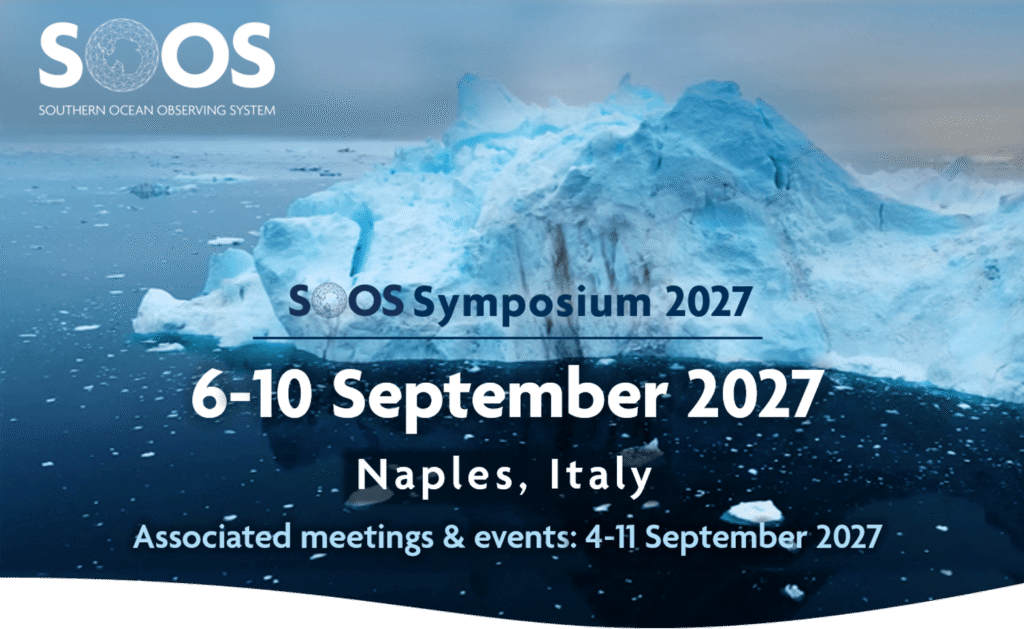
SOOS Symposium, 6–10 September 2027, Naples (Italy)
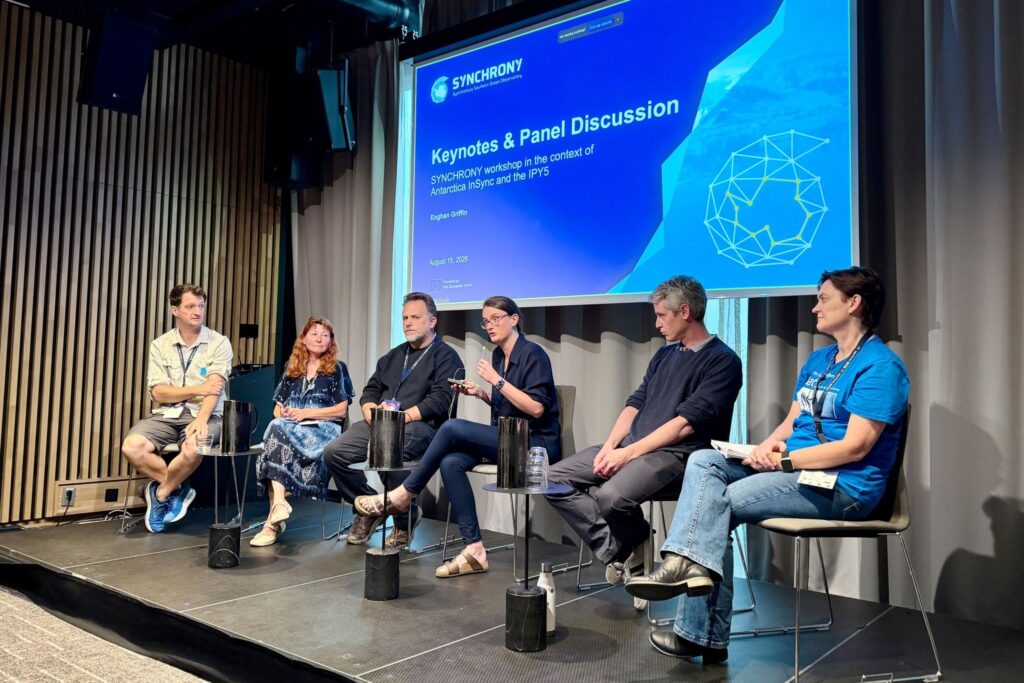
SYNCHRONY Workshop during the SCAR OSC 2026
A new observing system for the Southern Ocean
New open positions:
Join SYNCHRONY
Communications Coordinator for the SYNCHRONY Project (d/m/f/x)
Project-wide national and international communication within SYNCHRONY offers a wide range of creative possibilities: you will identify relevant core themes, develop strategic communication campaigns and implement them in close collaboration with the partners and the supporting agency, ESCI. Upon completion of the project, you will summarise key findings and insights and compile them into the final reports. This job advertisement is only available in German!
Partners

Alfred Wegener Institute – Helmholtz Centre for Polar and Marine Research (AWI)
United Kingdom Research and Innovation (UKRI-BAS)
Federal Maritime and Hydrographic Agency (BSH)
Centre National de la Recherche Scientifique (CNRS)
Consorzio Nazionale Interuniversitario per le Scienze del Mare Associazione (CONISMA)
Council for Scientific and Industrial Research (CSIR)
European Polar Board (EPB)
European Science Communication Institute GmbH (ESCI)

ETT Spa (ETT)
Euro-Argo ERIC (EURO-ARGO)
Institut Français de Recherche pour l’Exploitation de la Mer (IFREMER)
Consiglio Nazionale delle Ricerche (CNR)
Korea Polar Research Institute (KOPRI)
Ludwig Maximilian University of Munich (LMU)
Mercator Ocean (MOI)
National Oceanography Centre (NOC)
Norwegian Polar Institute (NPI)

Royal Belgian Institute of Natural Sciences (RBINS)
Scientific Committee on Antarctic Research (SCAR)
Université de Bretagne Occidentale (UBO)

University of Canterbury (UC)

The University of Edinburgh (UEDIN)
University of Gothenburg (UGOT)
Catholic University of Louvain (UCLouvain)

University of Otago (UO)

University of Southampton (UoS)
University of Tromsø – The Arctic University of Norway (UiT)

Alfred Wegener Institute – Helmholtz Centre for Polar and Marine Research (AWI)

United Kingdom Research and Innovation (UKRI-BAS)

Federal Maritime and Hydrographic Agency (BSH)

Centre National de la Recherche Scientifique (CNRS)

Consorzio Nazionale Interuniversitario per le Scienze del Mare Associazione (CONISMA)

Council for Scientific and Industrial Research (CSIR)

European Polar Board (EPB)

European Science Communication Institute GmbH (ESCI)

ETT Spa (ETT)

Euro-Argo ERIC (EURO-ARGO)

Institut Français de Recherche pour l’Exploitation de la Mer (IFREMER)

Consiglio Nazionale delle Ricerche (CNR)

Korea Polar Research Institute (KOPRI)

Ludwig Maximilian University of Munich (LMU)

Mercator Ocean (MOI)

National Oceanography Centre (NOC)

Norwegian Polar Institute (NPI)

Royal Belgian Institute of Natural Sciences (RBINS)

Scientific Committee on Antarctic Research (SCAR)

Université de Bretagne Occidentale (UBO)

University of Canterbury (UC)

The University of Edinburgh (UEDIN)

University of Gothenburg (UGOT)

Catholic University of Louvain (UCLouvain)

University of Otago (UO)

University of Southampton (UoS)

University of Tromsø – The Arctic University of Norway (UiT)